
Nitrous Oxide
The laughing gas you may know from the dentist is now widely available in flavored canisters, and teens are at risk.
Introduction
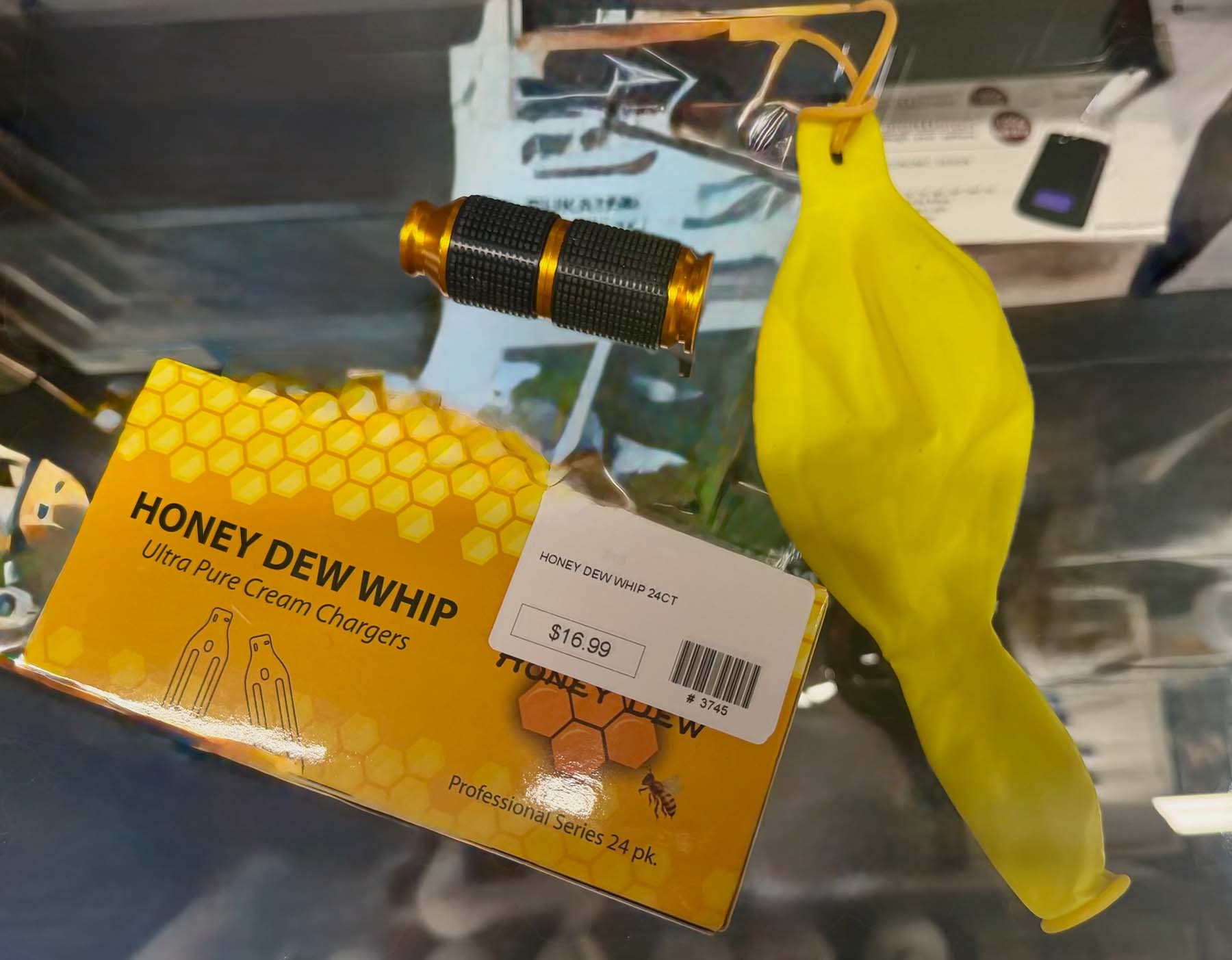
Walk into a gas station, vape shop, convenience store, or open Amazon and you can buy nitrous oxide by the tank. Some of it looks like a kitchen tool, and is marketed that way, with small steel “whipped-cream chargers.” More and more of it does not: cylinders sold in flavors like “Rainbow Candy” and “Strawberry,” under names like Galaxy Gas and Miami Magic. It is the same “laughing gas” a dentist uses and in most states nothing stops a teenager from buying it.
This brief covers the basics: what nitrous oxide is, how the products sold for inhaling differ from legitimate ones, and why the FDA and CDC are sounding the alarm. One Chance to Grow Up’s questions are always the same: how does this affect kids, and what can parents and trusted adults do to protect them?
At a Glance
- Sold as
- Laughing gas, nitrous, “NOS,” N2O, “whippets” or “whip-its,” “nangs”; brand names Galaxy Gas, Miami Magic, Baking Bad, Cosmic Gas, Whip-it!, FastGas
- What it does
- A dissociative gas that produces seconds-long euphoria and giddiness, partly by starving the brain of oxygen. It’s the same gas dentists use, but inhaled in unmeasured doses straight from a tank and completely unsupervised
- Common forms
- Small 8-gram steel “whippet” chargers, and large flavored tanks up to ~3.3 liters / 2,050 grams, often sold with balloons and metal dispensers for inhalation
- Where it’s sold
- Gas stations, convenience stores, vape and smoke shops, and major online retailers including Amazon, eBay, and Walmart, no prescription needed -- and in most states no enforced age limit
- Legal status
- Not a federally controlled substance; legal as a food propellant and medical gas. A bipartisan federal retail-ban bill got its first House hearing in July 2026, and several states have already restricted sales
- Youth Impact
- Went viral among teens on TikTok in 2024 under names like Galaxy Gas; bright, candy-flavored branding; U.S. nitrous-related deaths rose 578% from 2010 to 2023
What is nitrous oxide?
Nitrous oxide (N2O), or “laughing gas,” is a colorless gas that has been used in medicine for more than 150 years as an inhaled anesthetic and pain reliever, like at the dentist or during childbirth. It is also used as a food propellant: a small 8-gram steel cartridge, or “charger,” releases nitrous into a dispenser to whip cream. In those settings the dose is controlled and, for most people, low-risk. Because the gas is so familiar, it is widely assumed to be harmless — which is exactly what makes its misuse easy to overlook.
What is driving the current alarm is not the dental chair or any other medical setting. It is nitrous inhaled recreationally, released into a balloon and breathed in for a brief, dizzy high, in doses no one is measuring, from products sold for exactly that purpose. Users call the cartridges “whippets” or “whip-its.” Regulators, however, name it as a growing public-health problem.
What makes the “recreational” products different?
A culinary whipped-cream charger is an 8-gram cartridge meant for a kitchen. The products fueling the trend are more problematic. Large flavored tanks (some holding 3.3 liters / roughly 2,050 grams, the equivalent of hundreds of kitchen chargers in a single cylinder) are being sold in flavors like Rainbow Candy, Strawberry, and Mango Smoothie, packaged in bright, galaxy-and-candy graphics and bundled with balloons and metal “cracker” dispensers. Flavoring and a two-pound tank serve no culinary purpose. That form and that marketing make sense only if the product is meant to be inhaled as an intoxicant.
“Do not inhale or recreationally use any flavor of nitrous oxide in any size canister, tank, or charger. When inhaled, these products can result in serious adverse health effects, including death.” — U.S. Food & Drug Administration, safety advisory, updated June 2025
The labeling is often a half-hearted attempt at a safety warning, if products are labelled at all. Many tanks carry fine print reading “not for human consumption” or even “do not inhale,” printed on a product whose entire design, flavor, and sales funnel indicate otherwise. The FDA’s advisory names some brands directly, including Galaxy Gas, Miami Magic, Baking Bad, and Whip-it!, noting they are sold “as a food processing propellant for whipped cream” while being widely misused.
Why the FDA, poison centers, and researchers are concerned
In March 2025, and again in an update in June 2025, the FDA warned consumers not to inhale nitrous oxide products of any flavor or size, citing a rise in reported adverse events. The agency’s own list of possible effects is long: asphyxiation, blood clots, frostbite, abnormal blood counts, loss of consciousness, limb weakness, numbness, paralysis, psychiatric disturbances including hallucinations and paranoia, vitamin B12 deficiency, and death. For regular users, the FDA warns, the damage can be lasting, with “prolonged neurological effects, including spinal cord or brain damage, even after stopping use.”
Nitrous oxide inhalation in non-medical circumstances is dangerous in part due to how nitrous inactivates vitamin B12 in the body, and functional B12 deficiency can cause subacute combined degeneration of the spinal cord. This nerve damage shows up as tingling, leg weakness, an unsteady walk, and sometimes partial paralysis. Recovery requires stopping entirely and high-dose B12, and it is often slow and incomplete. Acute risks are separate and immediate. Because the high comes partly from oxygen deprivation, a heavy session can cause sudden death, and the pressurized gas can cause frostbite of the mouth, throat, and lungs.
Data behind the warnings is increasing sharply. A CDC report in April 2025 found that in Michigan, nitrous-related poison-center calls, emergency-department visits, and EMS responses in 2023 were four to five times their 2019 levels. Nationally, a July 2025 study in JAMA Network Open counted 1,240 nitrous-related deaths from 2010 to 2023, rising from 23 deaths in 2010 to 156 in 2023 — a 578% increase. Both reports likely undercount the problem since there is no routine test for nitrous in drug screenings or emergency room panels, so cases are easily missed. Harms cluster among people aged 20–39, but the marketing reaches much younger, and the adolescent brain is especially vulnerable to the kind of repeated exposure that drives dependence and nerve damage.
Why this is a youth issue
What makes nitrous a youth issue is not just the potential risks, but how this substance has gained popularity in social media content. In 2024, “Galaxy Gas” went viral on TikTok, Instagram, and YouTube, with influencers, streamers, and musicians filming themselves inhaling flavored nitrous. The trend spread widely enough that TikTok restricted searches for “galaxy gas,” replacing results with substance-use information, and the Atlanta company behind the brand announced in September 2024 that it would stop selling “out of an abundance of caution.” The brand went quiet but the prevalence of nitrous inhalation did not. Miami Magic and a dozen+ other brands still fill the same shelves.
The products are engineered to appeal to a trendy, youth-centric vibe: candy and fruit flavors, rainbow and “galaxy” graphics, and packaging that looks more like an energy drink than a drug. Sold at the counter and online with no age verification in most states, a flavored nitrous tank is, for a teenager, one of the easiest intoxicants in America to obtain. It is the same pattern One Chance to Grow Up warns about with intoxicating hemp and 7-OH: a real drug, disguised as a treat, sold beside the snacks with no one checking ID.
“I had no clue what it was. But when it’s misused it’ll kill you. Just like it did my son.” — Julia Charleston, founder of Parents Against Nitrous Oxide (PANOS), whose son died after prolonged nitrous use
What this looks like on the shelf
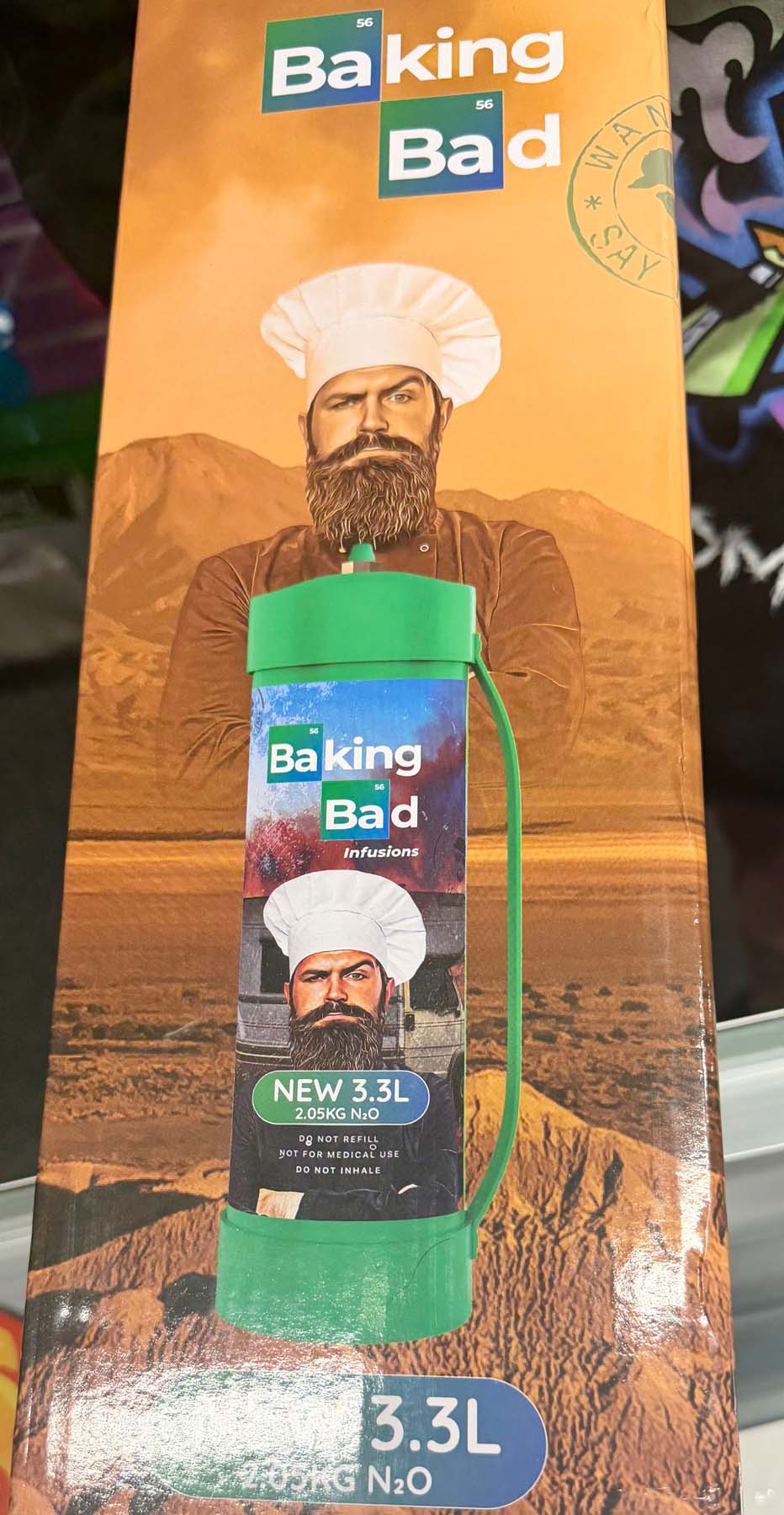
A debate gaining bipartisan momentum
Public and political attention is climbing fast. National investigative reporting has documented giant nitrous tanks for sale in convenience stores and vape shops nationwide, and parents who lost children to the gas have organized, arguing that nitrous slipped through the cracks precisely because it is legal and familiar.
Federal action is now in progress. In July 2026, the bipartisan Nitrous Oxide Safety Act (H.R. 7945), introduced by Rep. Kevin Mullin of California received its first public hearing in the House Energy and Commerce Committee. It would ban retail sales of nitrous for recreational use while preserving access for medical and culinary professionals. In the Senate, a separate bill from Senators Ron Wyden, Richard Blumenthal, and Alex Padilla, called the Nitrous Oxide Inhalation Prevention Act, takes aim at flavored cartridges and youth-targeted marketing and would expand the FDA’s authority over how the products are packaged, labeled, and sold. Senator Blumenthal accused the companies of “taking a page out of Big Tobacco’s playbook, targeting kids with colorful packaging and fruity flavors.” States have not waited for federal action to play out. Louisiana and Alabama have restricted or banned retail sales, Michigan has barred recreational use and added penalties for selling to minors, and Washington and Florida are weighing bills of their own.
Nitrous oxide gas has real medical value, and the people who use it in dentistry, medicine, and professional kitchens are not the problem. The target is the recreational retail market with its oversized flavored tanks, candy branding, marketing aimed at young people, and sales with no age check. That is the same line the leading federal bills draw: restrict the recreational channel while protecting the authorized ones.
What parents and trusted adults can do
- Look at what is actually on the shelf: Visit local smoke shops and gas stations, see what nitrous oxide products are for sale, and photograph them. Submit photos to our gas station drugs photo gallery at stopgasstationdrugs.org.
- Know the terminology: “Whippets,” “whip-its,” “nangs,” “NOS,” Galaxy Gas, Miami Magic, and “cream chargers” all point to the same thing. A flavored tank or a boxed “cracker” dispenser is a recreational product, whatever the label claims.
- Talk with kids about the disguise, not just the drug: Rainbow and candy-flavored packaging is designed to look harmless and fun; the “legal” and “just laughing gas” framing is exactly what makes it risky.
- Know the warning signs: Empty steel canisters or balloons, and (with heavy use) numbness, tingling, leg weakness, or an unsteady walk.
- Reach out to law enforcement and elected officials: Ask about the federal Nitrous Oxide Safety Act, your state’s status, and whether local retailers are checking ID and selling recreational tanks at all.
Nitrous sits in the same retail channel as intoxicating hemp, kratom and 7-OH, and other Gas Station Drugs, often sold by the same companies. The advocacy model that closed the intoxicating hemp loophole can help us address this reoccurring pattern of other new intoxicants targeting youth.
The Bottom Line
- Nitrous oxide is a medical and culinary gas that is also sold, legally, in flavored tanks designed to be inhaled for a brief high.
- It is not a federally controlled substance, and in most states there is no age limit on buying it at a store or online.
- The harms are real and adverse impact reports are rising: U.S. nitrous-related deaths climbed 578% from 2010 to 2023, and heavy use causes lasting nerve and spinal-cord damage.
- It increased in popularity after viral social-media trends and candy-flavored, kid-friendly branding.
- Federal and state action is advancing with bipartisan support.
- The goal must be to shut down the flavored, recreational retail market and keep these products away from kids.
Sources
- FDA, “FDA Advises Consumers Not to Inhale Nitrous Oxide Products,” safety advisory, first issued Mar 14, 2025; updated Jun 4, 2025 — fda.gov
- Vohra V, Matthews H, Stroh-Steiner G, “Notes from the Field: Recreational Nitrous Oxide Misuse — Michigan, 2019–2023,” CDC MMWR, Apr 10, 2025; 74(12):210–212
- Yockey RA, Hoopsick RA, “US Nitrous Oxide Mortality, 2010–2023,” JAMA Network Open, Jul 30, 2025; doi:10.1001/jamanetworkopen.2025.22164
- Nitrous Oxide Safety Act of 2026 (H.R. 7945), Rep. Kevin Mullin — House Energy & Commerce subcommittee hearing, Jul 2026; Nitrous Oxide Inhalation Prevention Act (Sens. Wyden, Blumenthal, Padilla), Jul 2026
- State actions: Louisiana and Alabama retail restrictions; Michigan recreational-use ban and penalties for sale to minors; Washington and Florida pending bills, 2024–2026
- InvestigateTV / Gray Media, “Threats to Our Youth” and “Congress moves forward on a bill to ban retail nitrous oxide sales,” 2025–2026; Parents Against Nitrous Oxide (PANOS)
- CBS News and Psychiatric Times reporting on the 2024 “Galaxy Gas” social-media trend and TikTok search restrictions; company withdrawal, Sept 2024
Stay in the loop
Stay ahead of new products reaching the shelves.
Get plain-language updates from One Chance to Grow Up on Gas Station Drugs including what's being sold, what to watch for, and what you can do about it.
Sign Up for Updates